A Traveler’s Primer to Cape Town’s History: From ‘Cape of Storms’ to Mandela
Walk Cape Town with context. This concise timeline connects Portuguese explorers, Dutch and British rule, and the long road to Mandela—plus the top sites to see it.
Intro
Cape Town dazzles with beaches, peaks and world-class food—but the city’s soul comes from centuries of human stories. If you’re planning museum stops, a Robben Island ferry, or a stroll through the Bo-Kaap’s colorful streets, a clear, traveler-friendly timeline will enrich every sight. Here’s a concise primer—from the first European landfalls and a fortress built of local stone to segregation’s scars and the balcony where Nelson Mandela spoke to a jubilant crowd in 1990—paired with the best places to see that history for yourself.
Before the ships: First Peoples and a well-used bay
Long before any European charts named this coastline, the Cape was home to Indigenous communities—the San (hunter-gatherers) and Khoikhoi (pastoralists)—whose archaeological traces dot the Peninsula in shell middens and rock art further inland. Seasonal grazing routes, coastal fishing, and trading with passing vessels formed a deep relationship with the land and sea. When you look across Table Bay today, remember it wasn’t an “empty” place; it was a lived-in landscape with established knowledge of weather, water and movement.
Where to see it
- Iziko South African Museum (Company’s Garden): Exhibitions on early human history contextualize the deep timescale of the region.
- Company’s Garden: While later in origin, it’s an accessible green space to imagine the Bay as a provisioning point long before empire.
1488–1652: Portuguese passages and the ‘Cape of Storms’
In 1488, Portuguese navigator Bartolomeu Dias rounded the Peninsula, recording a treacherous meeting of swells and winds he called Cabo das Tormentas—the Cape of Storms. Portugal’s King João II reframed the name to Cabo da Boa Esperança, the Cape of Good Hope, to signal a sea route toward Asian riches. Vasco da Gama followed in 1497, confirming the passage around Africa to India. The Portuguese did not settle here; they bartered with coastal communities and pushed on, but their voyages stitched the Cape firmly into global trade and geopolitics.
What to look for as you travel
- The weather: Frontal systems, south-easterly winds, and huge Atlantic swells give lived meaning to “Cape of Storms.” At Cape Point, stand by the old lighthouse and feel that name in your bones.
- The shipping lanes: From Bloubergstrand or Milnerton’s beachfront, watch the procession of container ships tracing a route born in the Age of Sail.
1652–1795: The Dutch VOC builds a refreshment station—and a colony
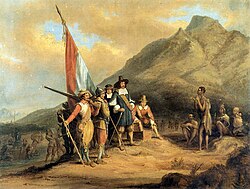
In 1652, the Dutch East India Company (VOC) sent Jan van Riebeeck to establish a refreshment station for ships. Fresh produce grown in the Company’s Garden, timber from the mountain slopes, and a defensive fort became the backbone of a busy port that soon sprawled into a settler colony. The stone-walled Castle of Good Hope (1660s) signaled permanence and military order.
Key changes under Dutch rule
- Enslavement and forced migration: To meet labor demands, the VOC imported enslaved people from East Africa, Madagascar, India, and Southeast Asia. Their descendants shaped language, religion, cuisine, and music—the foundations of what many know as Cape Malay culture.
- Farmlands and wine: Grapevines, wheat and citrus were introduced. The Constantia vineyards gained renown in Europe by the 18th century.
- Frontier conflicts: Expansion sparked violent dispossession and conflict with Khoikhoi communities.
Where to see it
- Castle of Good Hope: Star-shaped walls, cannons, and VOC emblems bring the 17th-century fortress to life.
- Iziko Slave Lodge (at the edge of Company’s Garden): A sobering, essential museum in a building that once confined hundreds of enslaved people.
- Bo-Kaap: A historic, predominantly Muslim neighborhood with cobbled streets, bright facades, and the Bo-Kaap Museum. Go with a local guide to understand homes, food history, and faith traditions born in the VOC era.
1795–1910: Britain arrives; slavery ends; gold and diamonds reshape power
Britain occupied the Cape in 1795 during the Napoleonic Wars, briefly handed it to the Batavian (Dutch) Republic in 1803, and retook it permanently after the 1806 Battle of Blaauwberg. Anglicization policies took hold in administration and schooling, and the port remained a strategic hinge between Atlantic and Indian Ocean routes.
Pivotal 19th-century shifts
- Abolition: Britain ended the slave trade in 1807 and emancipated enslaved people in the 1830s (with a harsh apprenticeship period). Freedom came, but inequality endured through land, wage, and social barriers.
- Language and identity: Dutch-descended settlers developed Afrikaans and, feeling alienated under British rule, many migrated inland in the 1830s–40s during the Great Trek.
- Mineral revolutions: Diamond (1867) and gold (1886) discoveries in the interior transformed the economy, accelerated urbanization, and intensified conflicts that culminated in the South African (Anglo-Boer) War of 1899–1902. Britain’s victory triggered deep political realignments.
Where to see it
- Cape Town City Hall (1910s Edwardian architecture): Later famous for Mandela’s 1990 speech, it also embodies turn-of-the-century civic ambition.
- Parliament and St. George’s Cathedral: Landmarks in the later political story, but rooted in 1800s Cape Town’s role as a colonial capital.
1910–1948: Union and a divided nation
In 1910, Britain created the Union of South Africa, welding former colonies and republics under a single dominion. Cape Town became the legislative capital. Despite limited voting rights for some under Cape law, political power increasingly centralized in the hands of the white minority. Racial segregation hardened through municipal bylaws and national statutes, laying rails for what would come next.
1948–1994: Apartheid, resistance, imprisonment—and a new dawn
The National Party won the 1948 election and formalized apartheid—an interlocking system of racial classification, residence control, and political disenfranchisement.
How it played out in Cape Town
- Group Areas Act (from 1950): Entire neighborhoods were reclassified. District Six—once a vibrant, mixed inner-city community—was bulldozed in the 1970s, and residents were forced to distant townships.
- Pass laws and policing: Everyday movement required permits. Protests grew, and the state tightened repression.
- Political prisoners: Robben Island became synonymous with resistance. Nelson Mandela served 18 of his 27 prison years there before transfers to Pollsmoor (in Tokai) and then Victor Verster.
The turn
Internal resistance, international sanctions, and reformist currents inside government intersected in the late 1980s. In February 1990, Mandela walked free and hours later addressed tens of thousands from the Cape Town City Hall balcony. The first fully democratic elections in 1994 made him South Africa’s first Black president. The Truth and Reconciliation Commission, chaired by Archbishop Desmond Tutu, held landmark hearings in Cape Town, including at venues near St. George’s Cathedral—the “people’s cathedral.”
Where to see it
- District Six Museum: Guided storytelling from former residents brings forced removals into sharp human focus.
- Robben Island Museum: Ferries depart from the V&A Waterfront’s Nelson Mandela Gateway. Former inmates often lead tours of the prison and quarry.
- Cape Town City Hall: Look up at the balcony where Mandela spoke on 11 February 1990. There’s a statue and interpretive panels.
- Pollsmoor Prison (view from outside in Tokai): Not a tourist site, but useful context when passing en route to the southern Peninsula.
Build your own history walk: a practical route
Day 1 (waterfront and the VOC city)
- Start at the V&A Waterfront’s Nelson Mandela Gateway. Pre-book Robben Island tickets—sailings can sell out days or weeks ahead, and weather cancellations do occur. Allow 3.5–4 hours round trip for ferry, bus tour and prison visit.
- Lunch by the water, then walk or rideshare to the Castle of Good Hope for the fort’s exhibits and ramparts.
- Stroll through the Company’s Garden to the Iziko Slave Lodge. Give this museum unhurried time—it’s compact but layered.
Day 2 (living memory in the CBD)
- Begin at District Six Museum for a guided tour with a former resident if available. Bring cash or a card for the bookshop—proceeds support community projects.
- Amble to Cape Town City Hall to see Mandela’s statue and the balcony. If Parliament precinct is open for public view (security conditions vary), pass by to connect the legislative landscape to the story you’ve heard.
- Optional: Continue to Bo-Kaap for a culture-and-cuisine walk with a local guide; visit a mosque if welcomed; try a cooking class to experience history you can taste.
Tips for visiting respectfully
- Ask before photographing people or private homes, especially in Bo-Kaap and informal areas.
- Choose community-led tours in Bo-Kaap, Langa or Gugulethu—your rand supports resident guides.
- Museum pacing: Pair intense sites (Slave Lodge, District Six, Robben Island) with fresh air in the Company’s Garden or a sea-front stroll to decompress.
Reading the landscape: why “Cape of Storms” still fits
Stand at Cape Point or along the Atlantic Seaboard and watch weather slam into the Peninsula. The Benguela Current pulls cold water up from the Southern Ocean; summer’s south-easter scours the sky; winter fronts stack swells on the Twelve Apostles. The drama you feel on cliff paths once terrified wooden ships—and it’s the same energy that sculpted the city’s history of harbors, lighthouses, and shipwreck lore.
Quick glossary of names and dates (pin this for your trip)
- 1488: Bartolomeu Dias rounds the Cape—Cabo das Tormentas.
- 1652: VOC founds a refreshment station; Company’s Garden established.
- 1660s: Castle of Good Hope constructed.
- 1806: British take permanent control after Blaauwberg.
- 1834–38: Emancipation of enslaved people in the Cape.
- 1899–1902: South African (Anglo-Boer) War.
- 1910: Union of South Africa formed; Cape Town becomes legislative capital.
- 1948: Apartheid begins.
- 1964–1982: Mandela on Robben Island (part of a 27-year imprisonment); later Pollsmoor and Victor Verster.
- 11 Feb 1990: Mandela’s Cape Town City Hall speech after release.
- 1994: First democratic elections.
Where to stay to make history-focused sightseeing easy
- If Robben Island, the Waterfront, and CBD museums top your list, base yourself within walking distance of the ferries, eateries, and heritage sites at the harbor. Walk to the V&A Waterfront from a Charming Apartment. is a stylish self-catering option that puts the Nelson Mandela Gateway, Zeitz MOCAA, and downtown history walks at your doorstep.
- Prefer sweeping Table Bay views and easy drives to the city? Milnerton’s beachfront offers postcard angles of Table Mountain and passing ships headed for the historic harbor. Check out Postcard Views of Table Mountain. Generator for elevator. or Amazing Ocean Views from Every Room. for bright, modern short-stay apartments with effortless access to both the CBD and West Coast viewpoints.
Final thought: carry context with you
Cape Town is as beautiful as it is complex. When you stand on the Castle’s bastions, stroll the Company’s Garden, ride the Robben Island ferry, or listen to a District Six story, you’re connecting threads that run from storm-tossed caravels to a modern constitutional democracy. Let this timeline be your pocket guide—and let the people you meet fill in the detail, flavor and nuance that make the Mother City unforgettable.